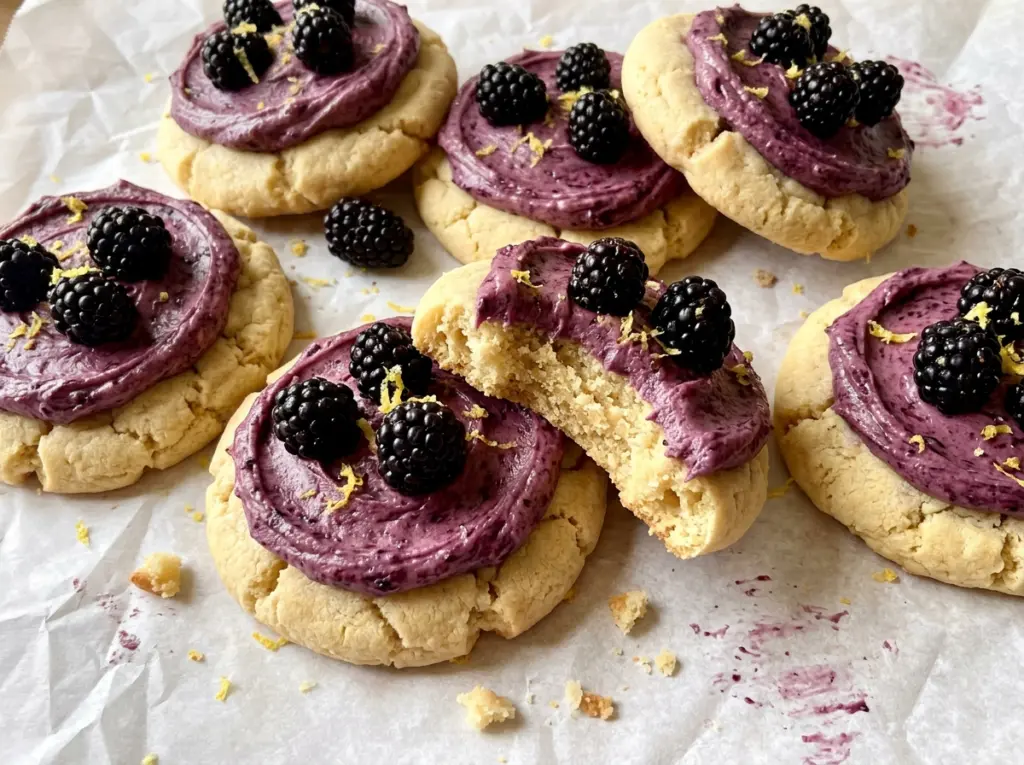
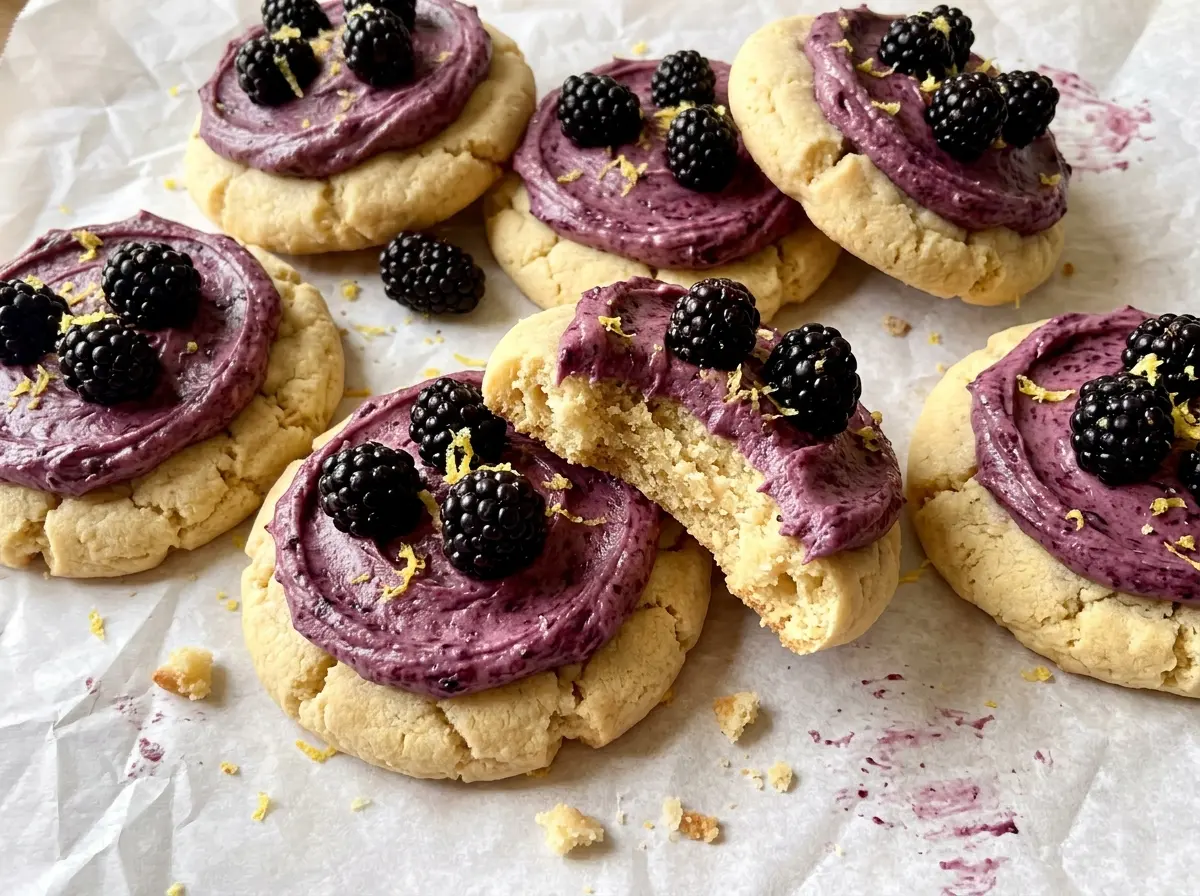
The edges of these cookies should look set when they come out of the oven, but the centers still feel soft. That’s how I get the thick, tender bite I want under a generous layer of blackberry frosting. These Crumbl Lemon Blackberry Cookies bake up large, so there’s room for the bright lemon base and creamy berry topping to each have their say.
I use both finely grated lemon zest and fresh lemon juice in the dough, then pair it with frosting made from cooked, strained blackberries. Reducing the berries concentrates their flavor without leaving seeds in the frosting. Once the cookies have cooled completely, the frosting spreads smoothly over the tops, and a short chill helps it set into a creamy finish.
Kitchen Note
Spoon the flour into your measuring cup, then level it off instead of scooping straight from the bag. Packed flour can make this dough dry and harder to shape into smooth, even disks.
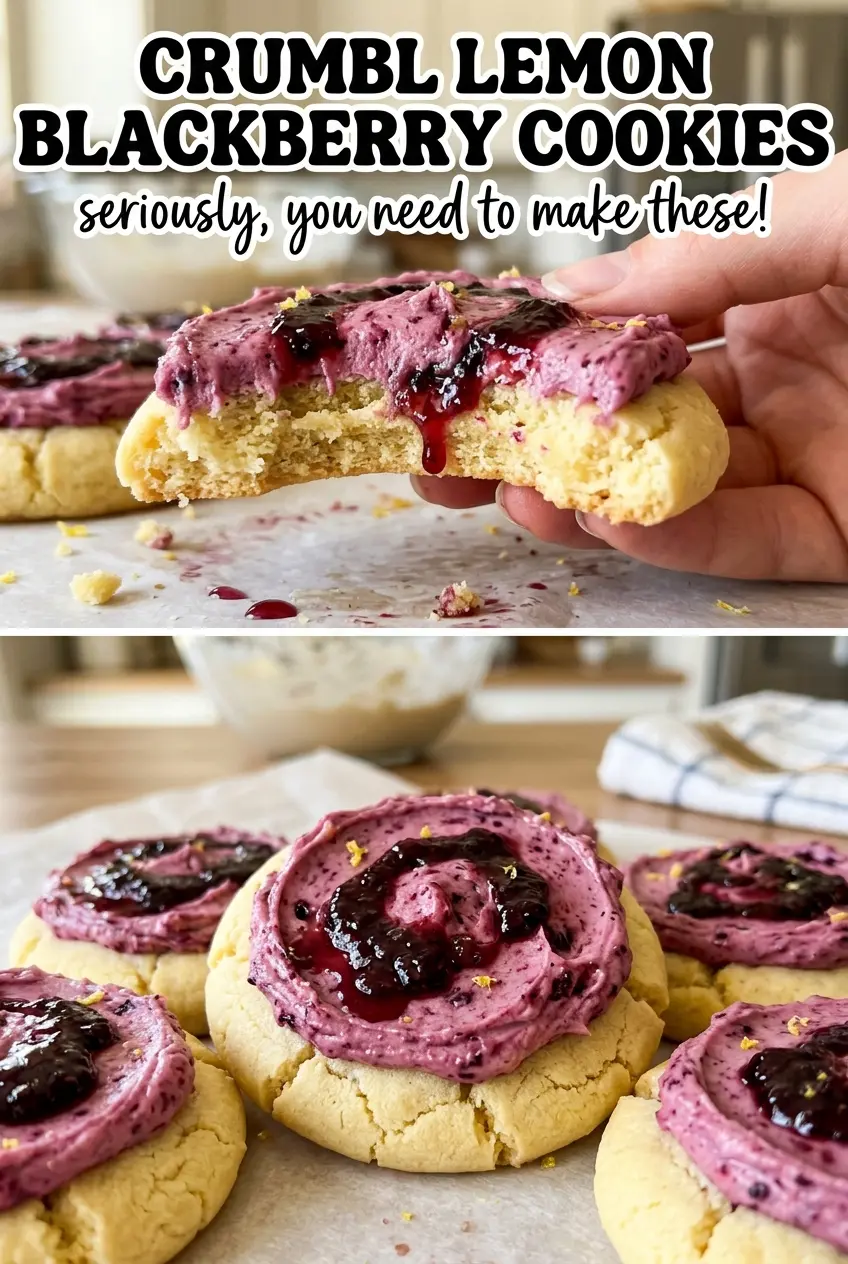
Save these Crumbl Lemon Blackberry Cookies for their soft lemon centers and creamy, seedless blackberry frosting.
Why the Lemon Base Stays Bright Under Blackberry Frosting
A thick cookie needs enough citrus character to hold its own once the frosting goes on. The lemon here comes from two places: zest brings the fragrant, aromatic part, while juice gives the dough a sharper citrus note. Together, they keep the cookie from tasting flat beneath a sweet, creamy topping.
The blackberry flavor has a different job. Cooking the berries down concentrates their fruitiness, so the frosting tastes distinctly of blackberry without needing a heavy layer on each cookie. Straining out the seeds also keeps the topping smooth against the soft cookie. The contrast is what makes each bite work: bright lemon underneath, creamy berry on top, with neither flavor disappearing.
What Each Ingredient Brings to These Lemon Blackberry Cookies
- Blackberries — Fresh berries cook down into a concentrated puree, and straining removes the seeds before they reach the frosting. Choose ripe berries with good color; the puree carries most of the berry flavor. Frozen berries release water differently, so fresh is the dependable choice for this method.
- Lemon zest and juice — Finely grated zest gives the dough its fragrant lemon lift, while fresh juice adds a sharper note. Use a fine grater and take only the yellow outer peel, not the bitter white pith. Juice on its own won’t replace the aroma of zest.
- Unsalted butter — Softened butter creams with the sugar to build the cookie dough, then combines with the cream cheese for the frosting. A standard grocery-store butter works well; the important detail is that it’s soft enough to beat smoothly, not melted.
- Cream cheese — Softened cream cheese gives the frosting its tang and body. Use regular cream cheese rather than a whipped spread, which is lighter and can make the topping loose. Let it soften so it beats smoothly with the butter.
- Powdered sugar — This sweetens and thickens the frosting while keeping its texture smooth. Add it gradually on low speed to limit a cloud of sugar and help it incorporate evenly. Granulated sugar won’t give the same creamy result.
- All-purpose flour — Spoon it into the measuring cup and level the top; this keeps the dough from taking on too much flour. For a gluten-free adaptation, replace it with the same amount of a cup-for-cup gluten-free baking flour blend made for baking. The cookies may have a slightly more delicate texture.
From Concentrated Berry Puree to Soft Lemon Cookies
Cook and Strain the Blackberries
Put the fresh blackberries in a small saucepan over medium heat. Cook for 8 to 10 minutes, stirring and mashing occasionally, until the berries collapse and release their juices. Press them through a fine-mesh strainer back into the saucepan to leave the seeds behind. Simmer the puree for 2 to 4 minutes, until it has reduced to 3 tablespoons, then transfer it to a small bowl and cool completely.
Cream the Butter, Sugar, and Lemon
Heat the oven to 350°F and line two 18×13-inch baking sheets with parchment paper. Beat 1 cup of softened butter with the granulated sugar on medium-high for 2 to 3 minutes, until light and fluffy. Add the eggs one at a time, then mix in the lemon zest and juice. In a separate bowl, whisk the flour, baking powder, baking soda, and salt before mixing them into the butter mixture on low, just until no dry flour remains.
Shape and Bake the Thick Cookies
Divide the dough into 8 portions, roll each into a ball, and flatten each ball into a 3/4-inch-thick disk. Set 4 cookies on each prepared baking sheet, leaving about 3 inches between them. Bake for 14 to 17 minutes, swapping and rotating the sheets halfway through so they bake evenly. Look for set edges and tops that are no longer shiny; the centers should still be soft.
Beat and Spread the Blackberry Frosting
Leave the cookies on the baking sheets for 10 minutes, then move them to a wire rack to cool completely. Beat the softened cream cheese with the remaining 1/2 cup of butter on medium speed until smooth. Add the powdered sugar a cup at a time on low, then beat in the vanilla and cooled blackberry puree until creamy. Spread the frosting evenly over the cooled cookies and refrigerate them for at least 20 minutes to set it.
Two Ways to Change the Lemon and Blackberry Balance
Make the frosting gluten-free
Swap the all-purpose flour for an equal amount of cup-for-cup gluten-free baking flour designed for cookies. It keeps the lemon-and-blackberry combination intact, though the finished cookies may be a little more delicate. Spoon and level the replacement flour the same way.
Keep the cookies lemon-only
Leave off the blackberry frosting and serve the baked lemon cookies plain. The result is less sweet and lets the citrus stand on its own; this is also the simplest option if you want to bake the cookies ahead and frost only the portion you plan to serve.
Storage and Reheating
- Refrigerator: Keep frosted cookies covered in the refrigerator and enjoy them within 3 to 4 days. The cookies become firmer when cold.
- Freezer: Freezing frosted cookies isn’t my first choice; the cream cheese frosting can lose its smooth texture after thawing.
- Reheating: Don’t reheat frosted cookies, since warmth softens the topping. Serve them chilled.
Questions That Come Up While Making These Cookies
Crumbl Lemon Blackberry Cookies
Ingredients
Equipment
Method
- Put the blackberries in a small saucepan over medium heat and cook, stirring and mashing occasionally, for 8 to 10 minutes until they collapse and release their juices.
- Press the berries through a fine-mesh strainer back into the saucepan, discarding the seeds.
- Simmer the puree for 2 to 4 minutes until reduced to 3 tablespoons.
- Transfer the puree to a small bowl and cool completely.
- Heat the oven to 350°F.
- Line two 18x13-inch baking sheets with parchment paper.
- Beat 1 cup of the softened butter and the granulated sugar in a large bowl with an electric mixer on medium-high for 2 to 3 minutes until light and fluffy.
- Beat in the eggs one at a time.
- Mix in the lemon zest and lemon juice.
- Whisk the flour, baking powder, baking soda, and salt in a separate bowl.
- Mix the flour mixture into the butter mixture on low just until no dry flour remains.
- Divide the dough into 8 portions.
- Roll each portion into a ball and flatten into a 3/4-inch-thick disk.
- Arrange 4 cookies on each baking sheet, spaced about 3 inches apart.
- Bake for 14 to 17 minutes, swapping and rotating the baking sheets halfway through, until the edges are set and the tops are no longer shiny while the centers remain soft.
- Let the cookies cool on the baking sheets for 10 minutes.
- Transfer the cookies to a wire rack and cool completely.
- Beat the cream cheese and remaining 1/2 cup softened butter in a large bowl on medium speed until smooth.
- Beat in the powdered sugar a cup at a time on low speed.
- Add the vanilla and cooled blackberry puree and beat until creamy.
- Spread the frosting evenly over the completely cooled cookies.
- Refrigerate the cookies for at least 20 minutes to set the frosting.
- Keep leftovers covered in the refrigerator.


