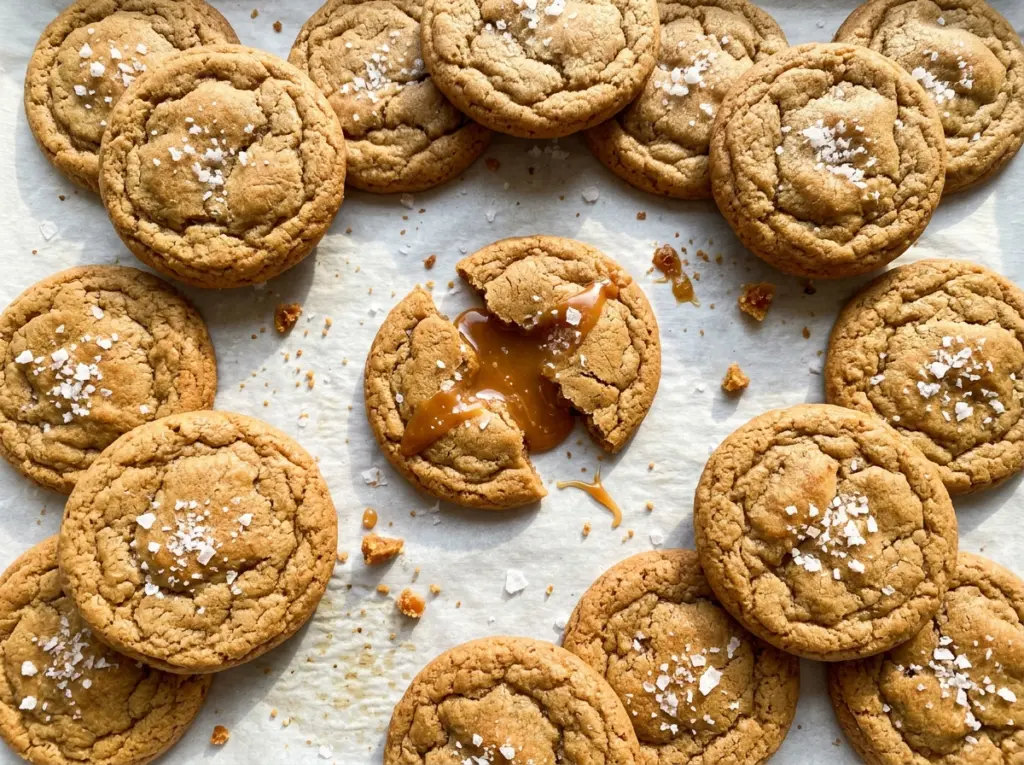
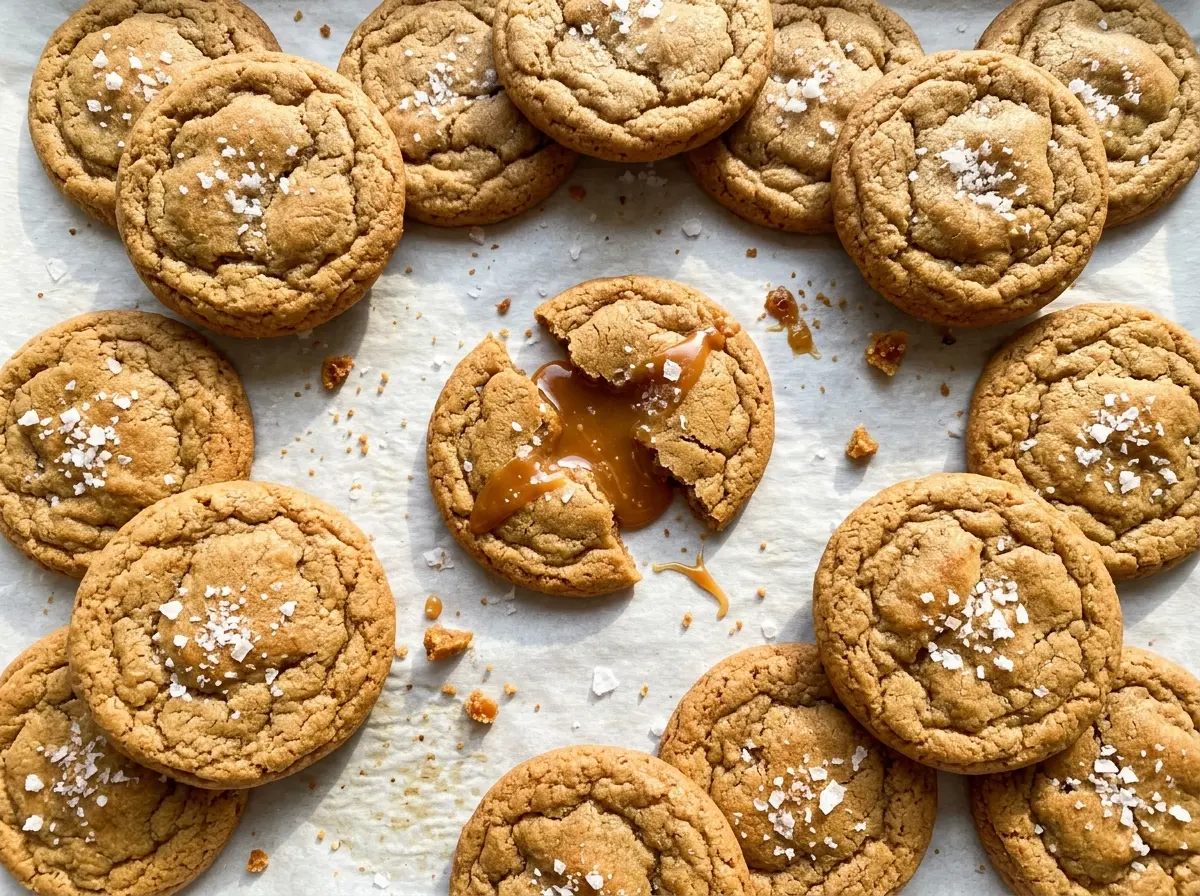
When the baking sheets come out, the edges are golden but the centers still look a little soft. That’s the moment I want for salted caramel cookies: they finish setting as they cool, while the caramel bits stay tucked into sweet, chewy pockets. Wait until the centers look completely firm and the cookies can turn out dry.
Light brown sugar gives these cookies a warm, mellow sweetness, and flaky salt on top keeps the caramel from tasting one-note. I like that the dough uses both a whole egg and an extra yolk, too; it makes a sturdy dough that still bakes up tender in the middle. The finished cookies have crisp edges, soft centers, and just enough salt to bring the caramel into focus.
Kitchen Note
Bring the egg and yolk to room temperature before you start mixing. They blend into the creamed butter more smoothly, so the dough comes together without looking uneven.
Save these salted caramel cookies for a bake when you want chewy centers, caramel pockets, and a little flaky salt on top.
Why One Whole Egg Plus a Yolk Makes These Cookies Tender
A cookie dough needs enough structure to hold its shape, but extra egg white can push the baked texture toward firm or cakey. Here, the whole egg helps bind the flour and butter, while the additional yolk brings richness without adding another white. That balance suits a cookie with caramel bits: the dough holds together around them, yet the centers stay tender.
The two sugars help shape the bite, too. Light brown sugar brings moisture and a gentle molasses note, while granulated sugar helps the edges bake up with a little more crispness. Neither sugar is just there to sweeten. Changing their balance changes the texture as well as the taste, which is why I keep the stated proportions for the classic batch.
That combination is also why I don’t treat these as thin, crisp cookies. The goal is a golden edge with a center that still looks slightly soft when the pan leaves the oven. As they cool, the cookies settle into a chewy middle instead of baking through to a dry, uniformly firm crumb.
What the Caramel Bits and Two Salts Bring to the Dough

- Caramel bits — These hold their shape better than caramel sauce, giving you distinct caramel pockets rather than adding extra moisture to the dough. Keep them in a cool, dry place until you’re ready to fold them in so they’re easy to distribute.
- Unsalted butter — Butter supplies the rich base and helps the cookies spread as they bake. Use it softened, not melted; a standard grocery-store butter works well here, and unsalted butter lets you control the salt in the dough.
- Light brown and granulated sugars — The brown sugar brings moisture and a mild molasses flavor; granulated sugar balances it and supports the crisp edges. Packed brown sugar gives a consistent measure, and there’s no need to seek out a specialty brand.
- Egg and extra yolk — They bind the dough and contribute richness. Use large eggs for the intended balance; the room-temperature detail in the Kitchen Note helps them mix in evenly.
- All-purpose flour — It gives the dough enough body to surround the caramel bits. Spoon flour into the measuring cup and level it rather than scooping straight from the bag, which can pack in too much and make the cookies dry.
- Vanilla, baking soda, and fine salt — Vanilla rounds out the brown sugar and caramel, baking soda helps the cookies spread and brown, and fine salt seasons the dough throughout. Measure the baking soda carefully; too much can leave an unpleasant aftertaste.
- Flaky sea salt — Its larger flakes give the tops a light crunch and a sharper salty contrast than fine salt. Use it as a finishing salt, not as a replacement for the fine salt mixed into the dough.
From Smooth Dough to Golden Edges: The Cookie Stages
Whisk the dry ingredients and cream the butter
Heat the oven to 350°F and line two baking sheets with parchment paper. Whisk the flour, baking soda, and fine salt together in a medium bowl so the leavener doesn’t land in one concentrated spot. In a large bowl, beat the softened butter with both sugars on medium speed for 2 to 3 minutes. Stop when the mixture looks light and fluffy; butter that’s still in firm lumps won’t cream evenly.
Mix in the eggs, then add the flour
Beat in the egg, egg yolk, and vanilla until they’re combined with the butter mixture. Add the dry ingredients and mix on low only until you no longer see dry streaks. Mixing longer at this point develops more gluten and can make the cookies tougher. Fold in the caramel bits so they’re spread through the dough without crushing them.
Chill and portion the dough
Cover the dough and chill it for 30 minutes. This gives the dough time to firm up, making it easier to portion and helping the cookies bake with defined edges. Scoop it into 2-tablespoon portions and arrange 12 on each prepared baking sheet, leaving about 2 inches between portions. Crowding them leaves less room for even spreading.
Bake until the edges turn golden
Bake both sheets for 10 to 12 minutes, switching their positions halfway through so they bake more evenly. Look for golden edges and centers that still appear slightly soft; don’t wait for the centers to look fully firm in the oven. Sprinkle the flaky sea salt over the cookies as soon as they come out. Let them cool on the baking sheets for 5 minutes, then move them to a wire rack to finish cooling.
Three Easy Ways to Adapt These Salted Caramel Cookies
Use dark brown sugar for a deeper caramel note
Replace the light brown sugar with the same amount of packed dark brown sugar. Its stronger molasses flavor makes the cookies taste deeper and a touch less delicate, while keeping the same basic dough method.
Make a gluten-free batch
Use a cup-for-cup gluten-free all-purpose baking flour blend in place of the all-purpose flour, and use gluten-free caramel bits. The cookies may have a slightly more delicate texture, so let them cool on the baking sheet for the full 5 minutes before moving them.
Skip the flaky topping for a sweeter finish
Leave off the flaky sea salt if you prefer a straightforward caramel-cookie flavor. Keep the fine salt in the dough; without the finishing flakes, the cookies will have less salty crunch and a sweeter overall impression.
Storage and Reheating
- Refrigerator: Store baked cookies in an airtight container for up to 5 days. They’ll become firmer as they sit, especially around the caramel.
- Freezer: Freeze cooled cookies in an airtight freezer-safe container for up to 2 months, separating layers with parchment. Thaw at room temperature.
- Reheating: Warm a cookie in a 300°F oven for about 3 minutes if you’d like it soft again. Avoid leaving it in until the caramel bubbles, since the hot caramel can become sticky and difficult to handle.
Questions That Come Up While Baking These Cookies
Salted Caramel Cookies
Ingredients
Equipment
Method
- Preheat the oven to 350°F.
- Line two baking sheets with parchment paper.
- In a medium bowl, whisk together the flour, baking soda, and fine salt.
- In a large bowl, beat the butter, brown sugar, and granulated sugar with an electric mixer on medium speed until light and fluffy, 2 to 3 minutes.
- Beat in the egg, egg yolk, and vanilla until combined.
- Add the flour mixture and mix on low just until no dry streaks remain.
- Fold in the caramel bits.
- Cover and chill the dough for 30 minutes.
- Scoop the dough into 2-tablespoon portions and arrange 12 portions on each prepared baking sheet, leaving about 2 inches between them.
- Bake both sheets for 10 to 12 minutes, switching their positions halfway through, until the edges are golden and the centers still look slightly soft.
- Sprinkle the cookies with flaky sea salt as soon as they come out of the oven.
- Let the cookies cool on the baking sheets for 5 minutes.
- Transfer the cookies to a wire rack.


