
The bottom of a flat glass dipped in sugar gives each dough portion a tidy, even press, and the cookies come out of the oven with pale tops and lightly golden bottoms. That little contrast is exactly what I want from Christmas Swig Cookies: a soft, substantial sugar cookie that can hold a generous swipe of frosting without feeling crumbly.
The dough uses both butter and vegetable oil, and the combination gives these cookies a different feel from a crisp, all-butter sugar cookie. I press the portions before baking rather than waiting for the dough to spread on its own, so each cookie has room for frosting and bakes at the same pace as its neighbors.
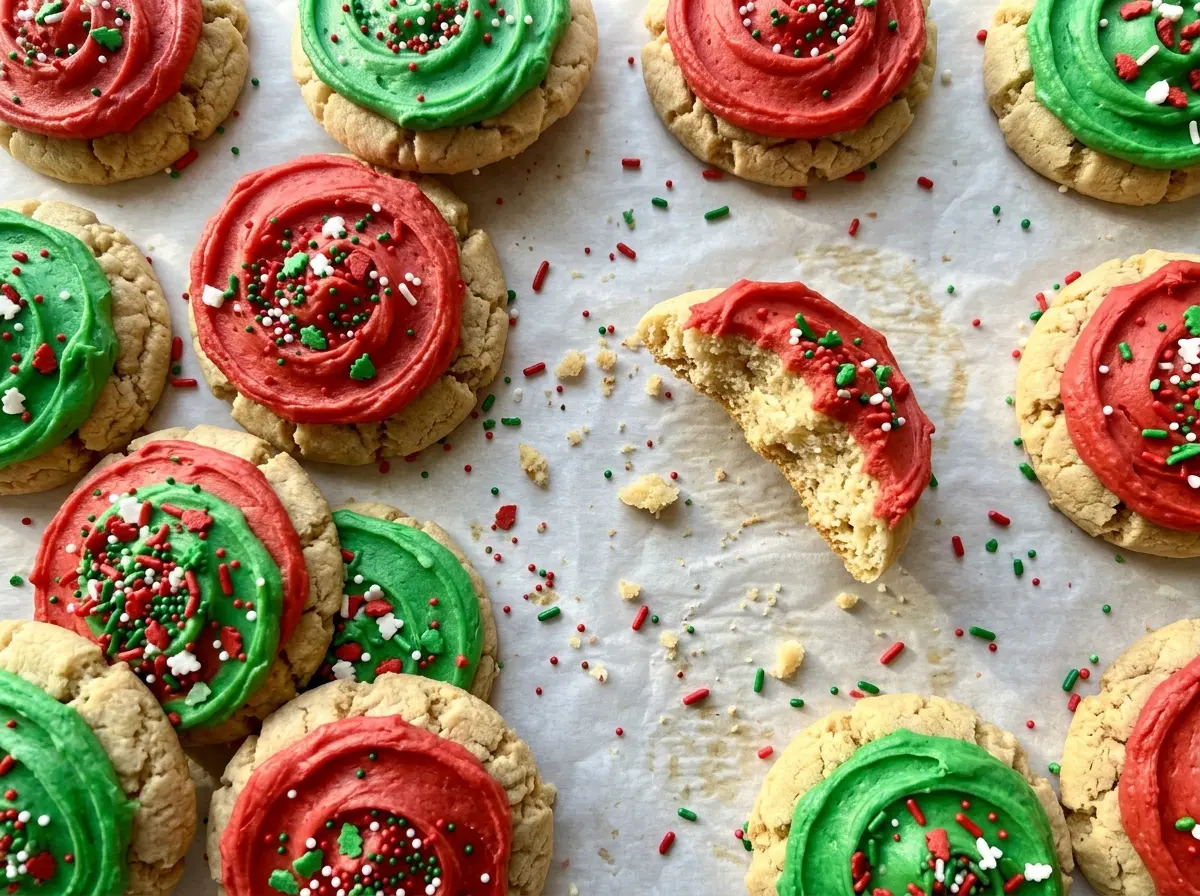
Once the cookies are completely cool, I tint the cream cheese frosting red and green, alternate the colors, and finish with Christmas sprinkles. The result is a thick, soft cookie with a smooth, tangy-sweet top and just enough crunch from the decorations.
Kitchen Note
I start the frosting with two tablespoons of milk, then check how it spreads before adding the last tablespoon. Adding that final bit gradually keeps the frosting thick enough to stay on the cookies instead of slipping toward the edges.
Save these Christmas Swig Cookies for a batch of soft sugar cookies with red-and-green cream cheese frosting and a festive sprinkle finish.
Why This Dough Uses Both Butter and Oil
Butter and oil do different jobs here, which is why I keep both in the bowl. Butter brings the familiar flavor you expect from a sugar cookie, while vegetable oil stays liquid after baking and helps the thick cookies keep a tender bite. Using only one changes the balance: an all-butter dough will bake up differently, and oil alone won’t give you that same buttery taste.
The way the fats meet the sugar matters, too. Beat the softened butter, oil, and sugar until creamy before the eggs go in; that gives the dough an even starting texture instead of leaving streaks of butter through it. The finished dough is meant to be pressed into flat rounds, not rolled out like a cutout cookie dough. Keep the butter softened rather than melted so it can cream smoothly with the oil and sugar.
That mix of fats is also why I don’t recommend swapping in a different oil or changing the butter-to-oil balance casually. The recipe’s texture depends on both. If you want a cookie with a crisp edge and a thinner shape, this dough isn’t built for that; these bake into soft, thick rounds ready for frosting.
What Gives These Cookies Their Soft Bite and Tangy Frosting

- All-purpose flour — Spoon it into the measuring cup and level the top rather than scooping straight from the bag. Packed flour makes a stiffer dough and can leave the cookies dry. I don’t replace it with a different flour unless I’m following a tested adaptation.
- Baking soda and cream of tartar — They work together to give the cookies lift and a subtle tang. Keep both in the mix; leaving out either one changes how the dough bakes, and they’re not interchangeable with each other.
- Granulated sugar — Most of it is creamed into the dough, and the remainder coats the flat glass used to press the portions. The sugar on the glass helps it release cleanly instead of sticking to the dough.
- Eggs — Large eggs bind the dough and give it structure. Use the size listed; changing egg size shifts the wet-to-dry balance in a batch this large.
- Block cream cheese — A softened block blends into a smooth frosting with the right body for spreading. Tub-style whipped cream cheese is lighter and looser, so it isn’t a reliable one-for-one swap here.
- Powdered sugar, vanilla, and milk — Powdered sugar sweetens and thickens the frosting, while vanilla rounds out the cream cheese tang. Milk loosens it for spreading, so add it gradually rather than pouring it all in at once.
- Gel food coloring and Christmas sprinkles — Gel coloring gives the frosting bold red and green without adding much liquid. The sprinkles add the festive finish; choose a mix you like, since they decorate the surface rather than changing the cookie dough.
From Creamed Dough to Frosted Christmas Cookies
Cream the Butter, Oil, and Sugar
Beat the softened butter, vegetable oil, and 1 1/2 cups of the granulated sugar in a large bowl with a hand mixer until creamy, about 2 minutes. Add the eggs one at a time, beating after each until incorporated. Scrape the bowl if you see butter clinging to the sides so the mixture stays even. Don’t add the flour before the eggs are mixed in.
Mix the Dry Ingredients in Gently
Whisk the flour, baking soda, cream of tartar, and salt in a separate bowl so the leaveners are distributed throughout. Add the dry mixture to the butter mixture in three additions, mixing on low after each. Stop as soon as no dry flour remains; beating longer can make the cookies tougher. The dough should be thick enough to scoop into portions.
Press the Portions into Even Rounds
Scoop the dough into 24 portions of about 1/4 cup each, arranging 12 on each parchment-lined 18×13-inch rimmed baking sheet. Dip the bottom of a flat glass in the remaining 1/4 cup sugar, then press each portion to about 1/2 inch thick. If the glass begins to stick, dip its bottom in the sugar again. Keeping the rounds similar in thickness helps them bake evenly.
Bake One Sheet at a Time, Then Cool
Heat the oven to 350°F and bake one sheet at a time for 9 to 11 minutes. Look for set edges and lightly golden bottoms; the tops should stay pale. If the tops are deeply browned, the cookies have gone further than this recipe needs. Let them sit on the baking sheet for 5 minutes before moving them to a wire rack to cool completely.
Tint and Spread the Cream Cheese Frosting
Beat the softened cream cheese in a medium bowl until smooth, then gradually beat in the powdered sugar. Mix in the vanilla and 2 tablespoons of milk, adding the remaining tablespoon only if the frosting needs it to become spreadable. Divide the frosting between two small bowls and tint one red and one green with gel food coloring. Spread the colors over the cooled cookies, alternate them across the batch, and finish with Christmas sprinkles.
Three Ways to Change the Look or Format
Make Two-Tone Swirls
Instead of spreading solid red and green frosting on separate cookies, place a small amount of each color side by side on a cookie and gently swirl where they meet. The colors blend at the border for a marbled look, while the cream cheese frosting stays the same.
Turn Them into Frosted Sandwich Cookies
For a different format, spread frosting on the flat side of one cooled cookie and gently sandwich it with another. The same cream cheese frosting becomes a soft filling, and each serving feels richer than a single frosted cookie.
Adapt the Flour for a Gluten-Free Batch
Replace the all-purpose flour with the same volume of a cup-for-cup gluten-free baking blend formulated for cookies, ideally one that contains xanthan gum. The dough may feel a little different, and the baked cookies can be more delicate, so let them cool fully on the pan before moving them to a rack.
Storage and Reheating
- Refrigerator: Keep frosted cookies in an airtight container for up to 4 days. The frosting firms up when chilled, and the cookies will be softer at room temperature.
- Freezer: Freeze the cooled, unfrosted cookies in an airtight container with parchment between layers for up to 2 months. Thaw them, then frost and decorate.
- Reheating: These are best served without reheating. Let a chilled cookie lose some of its refrigerator chill before serving; microwaving can melt the cream cheese frosting and make it slide.
Questions That Come Up While Making Christmas Swig Cookies
Christmas Swig Cookies
Ingredients
Equipment
Method
- Preheat the oven to 350°F.
- Line two 18x13-inch rimmed baking sheets with parchment paper.
- In a large bowl, beat the butter, oil, and 1 1/2 cups of the granulated sugar with a hand mixer until creamy, about 2 minutes.
- Beat in the eggs one at a time until incorporated.
- In a separate bowl, whisk together the flour, baking soda, cream of tartar, and salt.
- Add the dry ingredients to the butter mixture in three additions, mixing on low just until no dry flour remains.
- Scoop the dough into 24 portions of about 1/4 cup each and arrange 12 on each baking sheet.
- Dip the bottom of a flat glass in the remaining 1/4 cup granulated sugar.
- Press each dough portion to about 1/2 inch thick.
- Bake one sheet at a time for 9 to 11 minutes, until the edges are set and the bottoms are lightly golden; the tops should remain pale.
- Cool the cookies on the baking sheets for 5 minutes.
- Transfer the cookies to a wire rack to cool completely.
- Beat the cream cheese in a medium bowl until smooth.
- Gradually beat in the powdered sugar, then the vanilla and 2 tablespoons of milk.
- Add the remaining tablespoon of milk if needed for a spreadable frosting.
- Divide the frosting between two small bowls.
- Tint one portion red and the other green with gel food coloring.
- Spread the frosting over the cooled cookies, alternating colors.
- Decorate with the Christmas sprinkles.


